
Suzy Rent joins NVIDIA Inception Program to modernize renting in the Philippines
6 min read
08/21/2026Loading...
Loading...
Metro Manila’s rental market has a strange problem. There are more empty condos than ever. At the same time, many renters still feel like affordable places are hard to find.
According to Colliers Philippines, residential vacancy in Metro Manila is projected to peak at 25.6% by the end of 2026, an all-time high. In simple terms, roughly one in four residential units in the market could be vacant.
Normally, when there are more available units, renters expect prices to soften. More vacant units should mean more competition among landlords. More competition should mean better deals.
But for many people looking for a condo for rent in Metro Manila, especially near work, school, or major transport routes, the experience does not always feel cheaper.
So what’s going on?
Metro Manila’s condo oversupply is not happening in the same way everywhere.
Data projections show that the Bay Area will face the most severe oversupply risk, with vacancy expected to approach 60% by end-2026. That is a very different picture from core business districts, where demand tends to be more resilient. [1] Earlier data also indicated that submarkets like Makati CBD, Rockwell Center, and Ortigas Center had vacancies below 15%, even as broader Metro Manila vacancy was already elevated. [2]
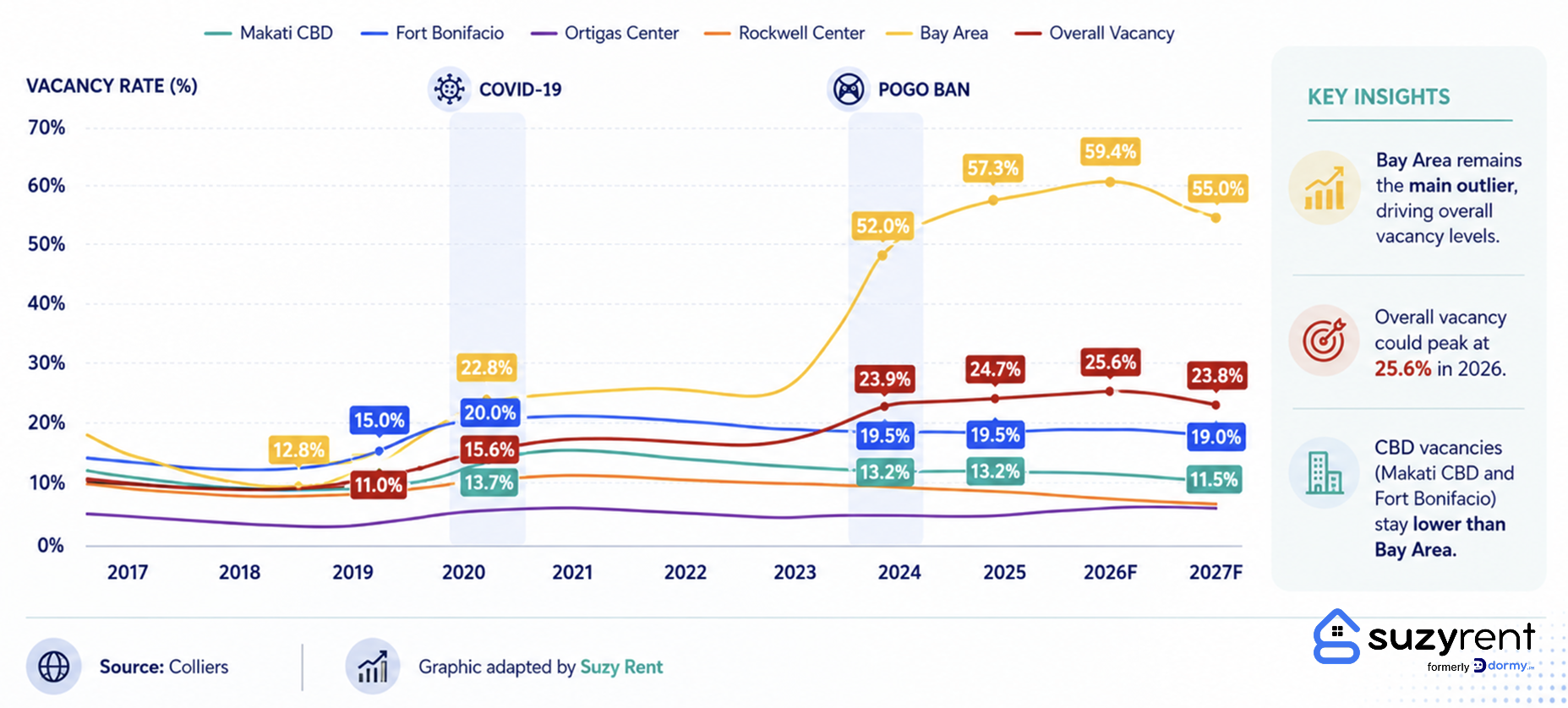
That means the “empty condo” problem is highly localized.
There may be many vacant units in some parts of the metro, while the areas renters most want — near offices, universities, transit, and lifestyle hubs — may still have limited affordable supply.
For renters, this creates a frustrating situation: the market may have a lot of available units, but not always in the right location, at the right price, or with the right lease terms.
The supply issue is not just about units that are empty today. It is also about the number of units still waiting to be absorbed by the market.
Colliers reported that Metro Manila’s unsold condo inventory stood at 79,200 units by Q4 2025. It also noted that nearly 30,000 unsold ready-for-occupancy units were concentrated in areas such as Cubao–New Manila, Quezon City, the Bay Area, Pasig, and Alabang–Las Piñas.
Another 13,000 new condominium units are expected to be completed in Metro Manila in 2026, almost double the 2025 level, with major supply coming from the C5 Corridor and Bay Area.
That adds more pressure to a market that is already trying to absorb years of condo launches, investor purchases, and shifting renter demand.
This is the big question renters are asking:
If so many condos are empty, why is rent still expensive?
The answer is that vacancy can pressure rents, but it does not automatically make every rental affordable.
It would not be accurate to say rents never went down.
The Philippine News Agency reported that condominium rental rates declined after the exit of POGOs, with the decline most visible in the Manila Bay area; citing Leechiu Property Consultants, PNA reported that average rent per square meter in the Bay Area was down 52% compared with the first quarter of 2020. Alabang was down 39%, Ortigas was down 22%, and Makati was down 18%.
But the same report also said rental rates in the Taguig area rose 17%, while BGC was up 3%.
In other words, Metro Manila is not moving as one market. Some areas are weaker. Some are recovering faster. Some premium locations still command strong rents.
A vacant unit is not free for the owner.
Condo owners may still have monthly association dues, maintenance costs, repairs, property-related expenses, and in many cases, loan payments. Association dues are usually collected monthly and are used for maintenance, common areas, facilities, and security, among other building expenses.
Because of these costs, some landlords may resist lowering rent too much, especially if they are trying to cover monthly payments or protect their expected investment return.
That does not mean every landlord is pricing correctly. It simply explains why some owners would rather wait longer for a tenant than immediately cut rates.
This is the affordability gap. A unit can be vacant and still be too expensive for the average renter.
For example, a young professional looking for a place near Makati, BGC, Ortigas, Taft, Katipunan, or Pasig may not benefit from oversupply if the available units are priced above their budget, require multiple months of upfront payments, or are located too far from their daily routine.
At its core, the price at which supply was purchased and consequently computed its estimated rental yields assuming adequate occupancy remains a mismatch to the current prices that average renters can afford.
Core business districts tend to have stronger demand because people want to live near jobs, schools, hospitals, transport, and lifestyle centers.
BusinessWorld reported that rents in Bonifacio Global City and Taguig had already exceeded pre-pandemic numbers, while other locations remained at a significant discount. Property analysts also noted that return-to-office mandates, expatriates, students, and professionals may continue supporting rental demand in selected areas.
This return helps explain why renters may still struggle to find cheaper units in prime locations, even while other condo markets have high vacancy.
Another possible factor is landlord behavior.
Some property owners may prefer to keep asking rents high while waiting for a tenant who can meet their target price. Others may offer concessions instead of visibly lowering the rent, such as furnishing upgrades, free parking, lower deposits, or more flexible terms.
This is especially possible in buildings where owners want to avoid setting a lower reference price for future leases.
For renters, this means negotiation can matter. A listing price is not always the final price, especially in submarkets with high vacancy or many similar units.
If you are looking for a condo for rent, apartment for rent, room for rent, or roommate setup in Metro Manila, the market may offer more opportunities than it seems — but you need to know where the leverage is.
Areas with high vacancy or many ready-for-occupancy units may give renters more room to negotiate. This could include asking for:
lower monthly rent
reduced security deposit
free parking
included association dues
basic furniture or appliances
shorter lease terms
flexible move-in dates
But in high-demand areas like BGC, Makati CBD, Ortigas, Taft, Katipunan, and other university or office zones, cheaper options may still move fast.
The best strategy is to compare listings across nearby neighborhoods, not just one exact location. A slightly less central area with better transport access may offer better value than a premium building in the middle of a CBD.
For landlords, the market is becoming more competitive.
If vacancy stays high, renters will have more choices. That means landlords may need to compete not only on price, but also on value. The strategy for landlords is to build a stronger property image, attracting higher quality tenants, this means:
clearer listing photos
transparent pricing
faster replies
better maintenance
reliable internet options
flexible terms
move-in ready furnishing
fair rules around deposits and dues
In a market with many available units, renters are not just choosing a condo. They are choosing the landlord, the building, the location, and the total monthly cost.
Metro Manila’s rental market is showing a bigger housing problem. A city can have thousands of vacant condos and still have a shortage of affordable, well-located rental homes.
The question is not only, “How many units are empty?” but rather: are these units priced, located, and designed for the people who actually need to rent?
Until the answer is yes, many renters will continue to feel squeezed in a market full of empty condos. For renters, rising vacancy may create room to negotiate, especially outside the most in-demand CBDs. For landlords, the message is clear: renters are comparing harder, asking better questions, and looking for total value — not just a unit.
This entire fragmentation is at the core of why we built Suzy Rent. Whether you are searching for a condo, room, apartment, or roommate setup, Suzy Rent helps make the rental search easier, clearer, and more renter-friendly.